


Heavy duty foldable mobility scooters for senior travelers
Could a scooter that folds neatly still be the wrong choice for your next flight? For air travel, folding alone doesn’t determine suitability; the scooter’s battery and the airline’s requirements matter too.
It’s understandable to want a scooter that makes travel more comfortable without adding uncertainty to your plans. The right choice depends on how much weight it must carry, where you’ll use it, and how you’ll transport it.
This guide explains how to assess weight capacity, compare three- and four-wheel designs, and evaluate flight suitability. You’ll also learn what to consider when reviewing safety features, brands, and warranties, so you can make an informed decision with your travel plans and independence in mind.
Table of Contents
What does mobility scooter weight capacity mean?
Heavy-duty folding scooters typically offer more capacity than standard travel scooters, but their added strength can make them less portable.
Weight Capacity Basics
A weight-capacity rating is the maximum combined load a scooter is designed to carry. Heavy-duty foldable mobility scooters can be harder to find than standard folding models, so compare the stated capacity with your actual riding needs.
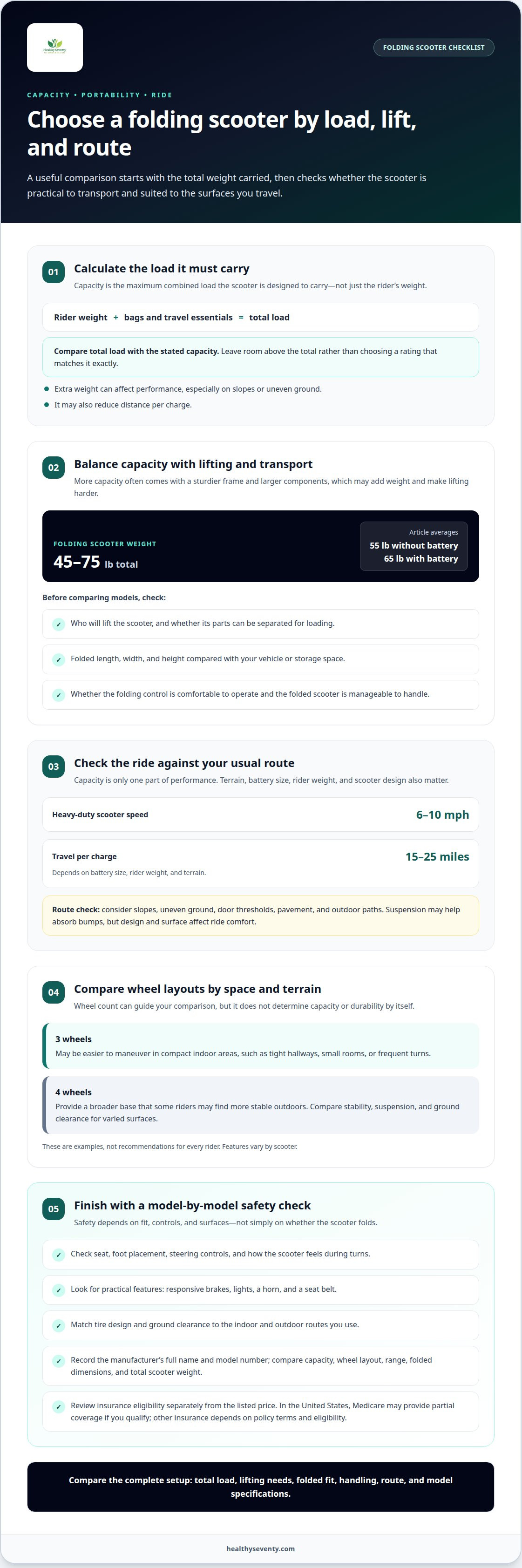
More capacity often means a sturdier frame and larger components, which may add scooter weight and make lifting harder. Folding scooters commonly weigh between 45 and 75 pounds in total; averages are about 55 pounds without the battery and 65 pounds with it. Consider who will lift the scooter and whether its parts can be separated for loading.
Passenger and Cargo Weight
Calculate the total load by adding the rider’s weight to anything carried on the scooter. Include bags, travel essentials, and other cargo instead of comparing the rider’s weight alone with the scooter’s capacity. For example, a rider carrying luggage needs capacity for both the rider and the luggage.
Choose a capacity rating that leaves room above your total load rather than matching it exactly. Extra weight can affect how a scooter performs, especially on slopes or uneven ground, and may reduce its distance per charge.
Speed and suspension matter alongside capacity. Heavy-duty scooters often reach 6-10 mph and travel 15 to 25 miles per charge, depending on battery size, rider weight, and terrain. Suspension can help absorb bumps, but the scooter’s design and the surfaces you travel over shape ride comfort. A heavier, higher-capacity model may suit longer trips, while a lighter folding scooter may be easier to lift into a vehicle.
What is the difference between a 3 wheel and a 4 wheel mobility scooter?
Folding mobility scooters come in three-wheel and four-wheel models, each suited to different spaces and routes. A three-wheel design can be easier to maneuver in compact indoor areas, while four wheels provide a broader base that some riders may find more stable outdoors. Neither wheel layout alone determines capacity or durability.
Start with your usual route. For tight hallways, small rooms, or frequent turns, consider whether a three-wheel model’s maneuverability suits your space. For outdoor paths or varied surfaces, compare four-wheel models for stability, suspension, and ground clearance. These features vary by scooter, so wheel count is only one part of the decision.
Treat these as examples, not recommendations for every rider.
To compare models, record the manufacturer’s full name and the model number, then match the specifications to your needs: wheel configuration, weight capacity, range, folded dimensions, and total scooter weight. A listing that says “four-wheel” doesn’t tell you the maximum capacity or whether the scooter will fit in your vehicle. The model number helps distinguish versions sold under the same brand.
Prices vary with features, but a price alone can’t show whether a scooter fits your body, home, or travel routine. Prioritize capacity and handling, then consider portability and durability. For a practical next step, explore mobility scooter options for seniors suited to everyday movement.
Are folding disability scooters safe for seniors?
Safety depends on fit, controls, and the surfaces you travel over, not just whether the scooter folds. For example, a scooter suited to smooth indoor floors may be less comfortable on uneven outdoor paths.
In the United States, Medicare may provide partial coverage for a folding scooter if you qualify. Other insurance coverage depends on the policy’s terms and eligibility criteria.
Folded dimensions matter for storage and transport. Before choosing, note the scooter’s folded length, width, and height, then compare them with your car trunk or storage space. Consider its weight too: a compact folded shape can still be difficult to lift. If the scooter folds with a button, consider whether you can operate the control comfortably and manage the folded scooter safely.
To assess stability, consider the complete setup rather than relying on the word “bariatric.” Review the seat, foot placement, steering controls, and how the scooter feels during turns. Look for practical safety features such as responsive brakes, lights, a horn, and a seat belt. Match the tires and ground clearance to your usual routes, including door thresholds, pavement, and outdoor paths. A scooter designed for smooth floors may suit different terrain from an outdoor model.
Prices and costs vary by model and included features, so compare listings by their full specifications rather than a headline discount. A promotional discount changes the amount due, but doesn’t show whether the scooter fits your needs. Prioritize weight capacity, folded dimensions, and safe handling before considering discounts. Keep model details together so you can compare the same features across options.
Use this simple review before deciding:
Measure available storage spaces and compare them with folded dimensions.
Consider lifting, folding controls, brakes, and visibility.
Match tire design and ground clearance to indoor and outdoor routes.
Review insurance eligibility separately from the scooter’s listed price.
Heavy-duty scooter brands and warranties
A brand name alone can’t tell you whether a scooter suits your needs. Compare each model’s capacity, portability, terrain suitability, and warranty terms.
Heavy-Duty Scooter Brands
Compare the specifications published for each model, not just the brand’s reputation. A lightweight folding scooter may simplify transport, while a heavier design may better suit demanding terrain. Compare the listed weight in pounds, wheel layout, range, and folded dimensions together. These details show how a model may fit your travel routine and storage space.
Separate a brand’s reputation from evidence about a specific model. A brand may sell both compact travel scooters and larger heavy-duty models, so one product’s specifications don’t describe every model. For a three-wheel scooter, consider maneuverability in tight areas; for a four-wheel scooter, assess whether its size suits your routes and storage.
Warranty Coverage
Typical heavy-duty scooter warranties cover electronics and drivetrain for 1-2 years. Battery coverage often lasts 6-12 months. These terms can differ by component, so read the coverage for the exact model. The headline warranty period alone doesn’t show which parts are covered or how long battery protection lasts.
Compare the written terms side by side: electronics, drivetrain, and battery coverage. Note each period, such as 1-2 years for electronics and drivetrain versus 6-12 months for batteries. Also review exclusions and the steps required to make a claim. A clear comparison helps you understand where coverage differs before choosing a scooter.
Create a model-by-model shortlist. Record the brand, model name, weight in pounds, transport needs, intended terrain, and warranty period. Then compare those details with how often you’ll fold and move the scooter. A model that fits your daily routine may suit you better than one chosen solely for its brand name.
Explore foldable mobility scooter options as you compare features and warranty considerations for senior travel.
Healthy Seventy: Foldable Mobility Scooter for Seniors
Healthy Seventy offers the Foldable Mobility Scooter for Seniors for people considering a mobility aid for everyday outings or travel. Use this guide’s criteria to identify what matters most, such as carrying capacity, folding and transport needs, and the routes you expect to travel. These priorities can help you decide whether a foldable scooter suits your routine.
If a scooter isn’t the right support for every situation, Healthy Seventy also offers the VOCIC Upright Walker for Seniors and Orthofeet Orthopedic Walking Sneakers. Each supports a different mobility need, so consider which option best suits your day-to-day activities.
Explore mobility options with Healthy Seventy and choose the support that fits your routine.
Make room for the journeys you value
Choosing mobility support is also a choice about how you want everyday life to feel: visiting family, stopping at a favorite park, or taking an unhurried trip across town. Let the plans that matter to you guide your decision, rather than choosing a model simply because its label sounds powerful. A suitable heavy-duty foldable mobility scooter should fit the way you want to move, travel, and take part in life.
Take time to picture your routine: where the scooter will be stored, how outings will begin, and which tasks you want to manage independently. Including a trusted family member in the conversation can help turn your priorities into a practical choice while keeping your preferences at the center. The goal isn’t to limit your plans, but to choose equipment that supports the experiences you want to keep saying yes to.
When you’re ready to discuss your mobility needs, contact Healthy Seventy for help. Take the next step at your own pace, with your plans leading the way.
Frequently Asked Questions
Can I take a folding mobility scooter on a plane?
Sometimes, but folding alone doesn’t determine whether a scooter can travel by air. Airlines consider battery details, safe handling, and how the scooter is prepared for transport. Before booking, give the airline the scooter’s make, model, and battery information. Ask how to prepare it for airport handling, since procedures can vary by carrier.
Why Should You Choose a Foldable Mobility Scooter?
A foldable scooter can make storage and transport more manageable if your routine includes car trips, visits, or limited storage space. Folding may also make it easier to keep a mobility aid nearby when it’s not in use. Consider who will fold and lift it, and whether its folded shape suits your vehicle. This information is for educational purposes and doesn’t replace professional medical advice.
Are foldable scooters for adults easy to store in small spaces?
Foldable scooters can be easier to store than models that don’t fold, but the fit depends on the specific scooter and the space available. Measure the storage area’s height, width, and depth, then compare those measurements with the scooter’s folded dimensions. Allow clearance to open a closet or car trunk, and consider whether you can move the folded scooter into the space comfortably.
Some folding four-wheel mobility scooters are listed with a 350-pound capacity. Look at the manufacturer’s specification for the exact model, since capacity can vary between versions from the same brand. A model number helps distinguish those versions. Also consider whether the scooter’s size, controls, and intended travel conditions suit the rider, rather than selecting by the capacity figure alone.
What weight capacity qualifies a foldable mobility scooter as heavy duty?
The label doesn’t guarantee that every folding model meets that threshold, so use the model’s stated capacity as your guide. Compare the rating with the rider’s needs and intended use, and consider how folding and transport fit into daily routines.
What are the best heavy-duty foldable mobility scooters in the United States?
There isn’t one best choice for every traveler. Start with the rider’s needs, then compare each model’s stated capacity, folding design, battery details for air travel, and warranty coverage. A scooter suited to vehicle transport may not suit someone who prioritizes indoor maneuverability. Focus on model-specific specifications rather than broad brand claims, and choose the option that fits your travel routine.
Comments