


Best Mobility Scooters for Travel: 2026 Guide to Independent Adventures
Updated: Sep 16

Imagine watching your grandchildren run toward the shoreline while you remain behind, wondering if your equipment can handle the sand or the flight home. Does the dream of a European cruise or a simple road trip feel overshadowed by the logistics of your equipment? It's natural to feel a sense of hesitation when you're worried about airport security lines or the physical strain of lifting a heavy device into a car trunk. You deserve to focus on the memories you're making, not the battery regulations you're facing.
Finding the right mobility scooters for travel is the key to reclaiming that sense of spontaneous adventure. In this guide, we'll show you how to choose a device that offers true independence without the technical headaches. You'll learn about the 2026 FAA requirements for lithium-ion batteries and discover how modern, foldable designs weighing as little as 35 pounds can fit seamlessly into your life. We'll walk through everything from airline approval for batteries up to 300Wh to the best ways to keep pace with your family on every excursion.
Key Takeaways
Understand why the weight of the heaviest individual piece matters far more than the total weight when loading your device into a standard car trunk.
Navigate airport security with ease by learning the specific 2026 FAA battery requirements for mobility scooters for travel.
Identify the best scooter "superpowers" for your specific needs, whether you prioritize tight turning radiuses for cruise ships or maximum durability for city streets.
Learn the essential steps for booking flights and selecting cruise cabins that ensure your journey remains stress-free and accessible.
Discover how to prioritize your personal confidence and comfort to ensure you never miss a moment of exploration with your loved ones.
Table of Contents
Redefining Freedom: Why a Travel Mobility Scooter is Your Ultimate Vacation Partner
Travel is more than just a change of scenery. It's the laughter shared over a quiet dinner in Tuscany or the joy of seeing a grandchild's face light up at a theme park. For many, the fear of physical fatigue can make these cherished moments feel out of reach. Specialized mobility scooters for travel are designed to remove those barriers. These aren't the bulky, heavy machines you might see in a grocery store. Instead, they are precision-engineered, lightweight tools built specifically for the rigors of planes, trains, and automobiles.
Think of your device as "independence insurance." You might find that you can walk comfortably for most of your day, but having a scooter tucked in the trunk ensures you never have to say "no" to an invitation because a walk looks too long or a terminal seems too vast. It provides a safety net that allows you to conserve your energy for the activities that matter most, such as exploring a museum or navigating a bustling cruise ship deck.
The Shift Toward Active Aging in 2026
The landscape of retirement has changed significantly as we move through 2026. We're seeing a surge in "Silver Travelers," a generation that prioritizes vibrant, hands-on experiences over a sedentary lifestyle. Modern engineering has met this demand by creating devices that look more like high-tech accessories than clinical equipment. This evolution has effectively reduced the stigma once associated with mobility aids, turning them into symbols of a proactive life. A travel scooter acts as the sturdy bridge between your desire for exploration and your body's need for a supportive pause.
Travel Scooter vs. Standard Scooter: Key Differences
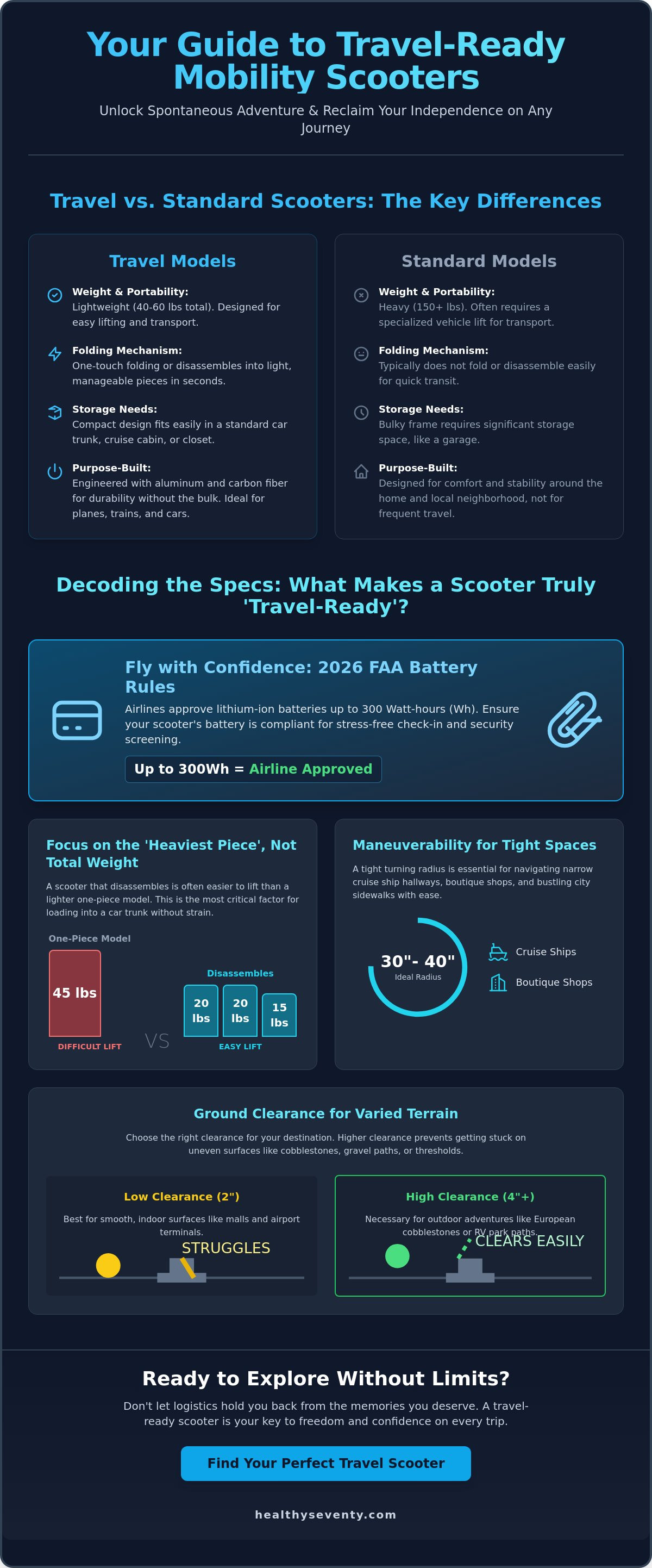
Understanding the technical differences is vital for choosing the right partner for your journey. While both types of devices offer assistance, their designs serve very different purposes. For a comprehensive Mobility Scooter Overview, it helps to recognize that travel models prioritize transit-friendly materials like aluminum and carbon fiber. Here are the primary distinctions:
Weight and Portability: A standard home-use model often weighs over 150 pounds and requires a specialized vehicle lift. In contrast, travel-specific models usually range from 40 to 60 pounds.
Folding Mechanisms: Travel models often feature a one-touch folding mechanism or can be disassembled into three or four lightweight pieces in seconds.
Storage Needs: Because they are compact, these devices fit into a standard car trunk or a small cruise ship cabin without requiring modifications to your environment.
Comfort Tradeoffs: While you might trade off the heavy-duty suspension and plush "captain's chairs" found in larger models, the gain in portability allows you to reach destinations that a standard scooter simply couldn't access.
By choosing a model specifically designed for transit, you're choosing a lifestyle that refuses to be limited by distance. You're opting for a tool that supports your vitality and keeps your social connections strong, no matter where the map leads you.
Decoding the Specs: What Makes a Scooter 'Travel-Ready'?
Have you ever looked at a technical spec sheet and felt more confused than when you started? It happens to the best of us. When you're researching mobility scooters for travel, the numbers on the page only matter if they translate to real-world ease. Understanding the "why" behind the data helps you choose a companion that feels like a help rather than a hindrance.
Many manufacturers highlight a "Total Weight" of 50 or 60 pounds. This is often a misleading statistic. If you're traveling with a spouse or friend, the "Heaviest Piece" is the number that actually determines if you can lift the device into a car trunk without strain. A scooter that disassembles into three 20-pound parts is often much more manageable than a one-piece 45-pound unit. It's about distributing the effort so you can focus on the destination.
Consider the environment of your upcoming trip. A tight turning radius of 30 to 40 inches is essential for the narrow hallways of a cruise ship or the compact aisles of a boutique shop. Similarly, ground clearance is your best friend on uneven ground. While a 2-inch clearance works for smooth mall floors, you'll want closer to 4 inches if your adventures include the cobblestones of Europe or the gravel paths of an RV park. Lithium-ion batteries have become the gold standard for these journeys. They offer a superior power-to-weight ratio, giving you more miles without the heavy lead-acid plates of older designs.
Folding vs. Disassembling: Which is Better for You?
One-touch folding mechanisms are a dream for those who want to avoid fumbling with latches. They're perfect if you have limited hand dexterity or need to transition quickly from a car to a sidewalk. However, disassembling models are often the unsung heroes for car travel. By breaking the scooter down, you distribute the weight, making it easier for a companion to help with the lifting. For those days when you only need a little support for shorter distances, a VOCIC Upright Walker can be an excellent, lightweight companion to keep in your vehicle alongside your scooter.
Battery Range and Charging Logistics
Will 10 miles of range be enough? If you're planning a full day at a theme park, you'll likely cover 5 to 8 miles. A 10-15 mile range provides a comfortable cushion so you never have to worry about a mid-day stall. "Off-board" charging is another feature to look for; it allows you to leave the heavy scooter in the car while you bring just the battery inside to charge overnight. Always ensure you carry your battery's certification to comply with FAA Battery Regulations for Air Travel. Carrying a physical copy of this document can prevent delays at the boarding gate. If you're ready to find a device that balances these technical needs with your personal comfort, exploring a Foldable Mobility Scooter for Seniors is a wonderful next step toward your next great journey.
The 2026 Roundup: Best Mobility Scooters for Travel
Choosing the right partner for your journey is a personal decision that balances your physical needs with your sense of adventure. In 2026, the market has evolved to offer specialized solutions for every type of traveler. Whether you're navigating the tight corridors of a historic hotel or the expansive terminals of a modern airport, there is a device designed to make your transit seamless. We have curated this list to help you identify which mobility scooters for travel align with your lifestyle and travel goals.
Foldable Mobility Scooter for Seniors (Healthy Seventy):Superpower: Seamless Folding and Versatility. Who it’s for: The traveler who needs a reliable, all-in-one solution that transitions effortlessly from a car trunk to a paved museum path.
SmartScoot:Superpower: Ultra-Lightweight Framework. Who it’s for: Solo adventurers who prioritize a frame that's easy to lift without assistance.
Pride Go-Go Endurance Li:Superpower: All-Terrain Adaptability. Who it’s for: Nature enthusiasts who want to explore gravel paths in National Parks or uneven RV campsites.
EV Rider Transport AF+:Superpower: Automatic Remote Folding. Who it’s for: Travelers with limited hand strength who prefer the scooter to do the heavy lifting of folding itself.
The Ultra-Lightweight Champion: Best for Air Travel
For the frequent flyer, every pound matters. The SmartScoot stands out as a top contender, weighing under 30 pounds when the battery is removed. This design allows you to pull the scooter behind you like a piece of carry-on luggage through the terminal. It's a game-changer for navigating long security lines and reaching your gate without fatigue. If you're exploring different ways to stay active while traveling, our Mobility Devices for Elderly guide provides even more context on choosing the right tools for your specific mobility level.
The All-Terrain Specialist: Best for RVs and National Parks
If your version of freedom involves the great outdoors, you'll need a device with a bit more grit. Models like the Pride Go-Go Endurance Li feature larger tires and enhanced suspension systems that handle grass and gravel with ease. While these models might add 10 to 15 pounds to the total weight, the tradeoff is a significantly smoother ride on unpredictable surfaces. Pairing an all-terrain scooter with non-invasive joint pain relief strategies ensures that your body feels as vibrant as your surroundings after a long day of exploring. These models often support a weight capacity of up to 330 pounds, providing a sturdy foundation for all-day excursions.
Regardless of which model you choose, always verify the manufacturer's warranty and the availability of local support in your destination. A trusted warranty is more than just a piece of paper; it's your assurance that your independence remains protected wherever your travels take you.
Navigating the Logistics: Planes, Trains, and Cruise Ships
Preparation is the secret to a stress-free journey. Once you've selected the right partner for your adventures, understanding the specific rules for different modes of transport ensures your focus remains on the scenery rather than the paperwork. Managing mobility scooters for travel requires a proactive approach, especially when transitioning through busy transit hubs where regulations are strictly enforced for everyone's safety.
When you're planning a road trip, don't rely on a visual estimate of your trunk space. Use a measuring tape to check the height, width, and depth of your cargo area against the folded dimensions of your device. It's helpful to practice loading and unloading the scooter at home several times before your departure date. This builds your confidence and ensures that you, or a travel companion, can handle the transition quickly at a crowded rest stop or hotel entrance. For peace of mind, pack a small maintenance kit containing hex keys, spare fuses, and any necessary international outlet adapters for your charger.
Understanding FAA and TSA Battery Rules
Flying with a mobility device is much simpler when you know the 2026 safety standards. The Federal Aviation Administration (FAA) and TSA allow lithium-ion batteries on planes, but they have specific thresholds. If your battery is between 160Wh and 300Wh, you must obtain airline approval at least 48 hours before your flight. Batteries under 160Wh generally don't require prior approval, but you must always remove the battery from the scooter and carry it with you in the cabin. It's never allowed in the cargo hold. You can find your Watt-hour (Wh) rating by multiplying the voltage by the amp-hours (V x Ah), which is usually printed clearly on the battery label.
Cruise Ship Accessibility Checklist
Cruise lines, including major carriers like Royal Caribbean, have standardized their policies in 2026 to align with international flight rules. To ensure a seamless boarding process, notify the cruise line of your equipment at least 30 days before sailing. This is also the time to confirm that your cabin is designated as "ADA accessible." Standard cabins often have narrow entryways that won't accommodate a scooter, even if it's folded. During the voyage, be mindful of the "Gangway Challenge." Depending on the tides and the port, the ramp connecting the ship to the shore can be quite steep. Having a scooter with a reliable braking system and sufficient motor power is essential for these transitions. If you're ready to secure a device that meets these rigorous travel standards, you can find our recommended foldable mobility scooter for seniors here to begin your next chapter of exploration.
Choosing Your Journey: How Healthy Seventy Curates Your Independence
Selecting from the best mobility scooters for travel is more than a logistical choice; it's a decision to stay present in your own life. While the weight and battery life are essential metrics, the ultimate goal is finding a device that makes you feel completely secure. When you trust your equipment, you stop worrying about the distance between the hotel and the museum. Instead, you focus on the conversation, the local cuisine, and the joy of shared experiences. Confidence is the final, most important specification for any traveler.
We believe that these devices represent a commitment to vitality rather than a sign of decline. Using a scooter is a strategic way to conserve your energy, ensuring you have the stamina for a late dinner or a sunset walk after a long day of sightseeing. It's about wisdom and planning for the best possible experience. By choosing to prioritize your comfort, you're protecting your ability to create lasting memories with the people you love most.
The Healthy Seventy Curation Process
Our research team spends hundreds of hours vetting products so you don't have to. We evaluate every recommendation based on ease of assembly and the intuitiveness of the controls. We prioritize brands that offer reliable national service networks, ensuring that help is available even when you're far from home. Above all, we look for "dignity in design." We believe your equipment should be a sophisticated extension of your lifestyle, blending modern aesthetics with the functionality you require for a smooth journey.
Next Steps: Embarking on Your Next Adventure
If you're still weighing your options, consider a brief consultation with a physical therapist to discuss your specific balance and strength needs. Their professional insight can help you decide between different stability features. Once you're ready to finalize your choice, use our comparison tools to find the perfect match for your next itinerary. Your next chapter of exploration is waiting to be written. We invite you to explore our curated Foldable Mobility Scooters for Seniors and take the first step toward your next independent adventure.
Your Next Great Adventure Awaits
The world is far too vast to be viewed from a hotel window. By understanding the nuances of battery compliance and the importance of a tight turning radius, you've already taken the most difficult step toward your next journey. Choosing the right mobility scooters for travel is about more than just transport; it's about ensuring you never have to miss a family dinner or a scenic overlook. You now have the knowledge to navigate airports and cruise terminals with total poise.
Our team has done the heavy lifting by vetting every model for ease of use and reliability. We focus on TSA and FAA compliance while ensuring every recommendation is backed by national warranty support. This expertly researched selection was designed specifically for users over 70 who refuse to let distance define their boundaries. Are you ready to reclaim your spontaneous spirit and explore with confidence?
View Our Curated Selection of Travel-Ready Mobility Scooters
Your vitality is your legacy. We're honored to be a partner in your journey toward a more active and connected lifestyle. Travel safely and enjoy every moment.
Frequently Asked Questions
Can I take my mobility scooter on a plane for free?
Yes, most airlines allow you to transport mobility devices at no extra cost. They are classified as essential medical equipment rather than standard luggage, so they don't count toward your baggage allowance. You should notify your carrier at least 48 hours before your flight to ensure they can accommodate the device and provide any necessary assistance during the boarding process.
What is the lightest mobility scooter for travel in 2026?
The lightest models in 2026 typically weigh between 35 and 40 pounds once the battery is removed. Some advanced carbon fiber designs have pushed these limits even further, making them incredibly easy for a companion to lift. These lightweight frames are specifically engineered to fit into a standard car trunk without requiring any specialized lifting equipment or vehicle modifications.
Do I need a special car lift for a travel mobility scooter?
No, you do not need a specialized lift for most travel-specific models. These devices are designed to fold into a compact shape or disassemble into several lightweight pieces that can be managed by hand. This portability is a major advantage over standard home models, as it allows you to use almost any sedan or SUV for your road trips.
Are all lithium batteries airline-approved?
No, approval depends entirely on the Watt-hour (Wh) rating of the battery. While many mobility scooters for travel are equipped with compliant batteries, some high-capacity versions exceed the 300Wh limit set by safety regulations. Always check your battery label for the specific rating and carry the manufacturer's certification document to ensure a smooth experience during security screenings.
How do I protect my scooter from damage during a flight?
You can protect your device by using a padded travel bag and securing any removable parts before gate-checking. It's a smart idea to take photos of your scooter at the gate to document its condition before it's loaded. You should also attach clear, simple instructions on how to put the scooter into "freewheel" mode so ground crews can move it safely without causing mechanical strain.
Can a travel scooter handle hills or steep ramps?
Most travel models can comfortably handle standard ADA-compliant ramps with an incline of up to 6 degrees. However, they aren't intended for very steep hills or rugged off-road terrain. If your vacation involves significant slopes, look for a model with a slightly more powerful motor and higher torque to ensure you maintain a steady and safe pace during your ascent.
What happens if my scooter breaks down while I am on vacation?
Choosing a brand with a national service network is the best way to handle unexpected repairs while away from home. Many top manufacturers offer warranties that allow you to receive assistance from authorized technicians in major cities. Carrying a small toolkit with spare fuses and a copy of your owner's manual can also help you resolve minor issues quickly so your itinerary stays on track.
Is it better to rent a scooter at my destination or bring my own?
Bringing your own mobility scooters for travel is usually the better choice because you're already familiar with the specific controls and comfort of your device. Renting can be unpredictable, as the available equipment may be bulky or difficult for you to operate. Having your own equipment ensures that your independence begins the moment you leave your front door and continues through every transit point.


Comments