


All Terrain Foldable Mobility Scooters: Compare Prices and Features
The most rugged-looking scooter isn’t automatically the best fit. An all-terrain foldable mobility scooter should match the ground you’ll travel, the space you have for transport, and your weight-support needs.
It’s understandable to focus first on rugged tires and the promise of outdoor freedom. But comfort and usability depend on how those features work together: clearance, folding design, tires, range, speed, and capacity all shape the experience. This guide compares the key model types and features, explains what ground clearance means for everyday routes, and helps you weigh the trade-offs so you can choose an option suited to your outings and transport needs.
Table of Contents
Which All-Terrain Mobility Scooter Should You Buy?
Choose by matching capacity, travel distance, terrain, and transport needs. Compare practical priorities, then check each model’s stated specifications, since features vary between scooters.
Choose the row that fits your regular routes and transport routine, then compare the actual model specifications.
Weight Capacity
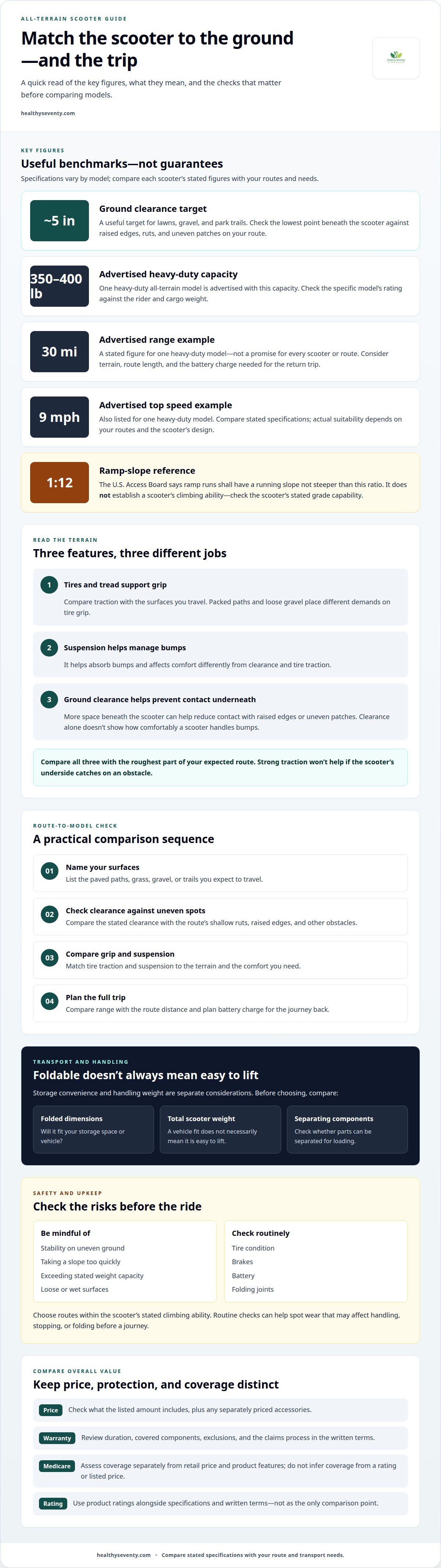
A heavy-duty all-terrain model is advertised with a 350-400-pound capacity, but the label alone doesn’t establish fit. This gives weight capacity a personal benchmark and helps distinguish higher-capacity options from foldable-first priorities.
Range, Speed, and Climbing Ability
One advertised heavy-duty model offers a 30-mile range and a top speed of 9 miles per hour. Treat those figures as comparison points, not as a promise for every model or route. For climbing ability, compare the scooter’s stated grade capability with the slopes you expect to travel. The U.S. Access Board says ramp runs shall have a running slope not steeper than 1:12 slope ratio; that ramp standard doesn’t itself establish a scooter’s climbing ability.
Portability and Scooter Weight
Foldable scooters can simplify storage and vehicle transport, but folding doesn’t tell you how much lifting is involved. Weight varies by model, so compare the folded dimensions, total scooter weight, and whether components separate for loading. A scooter may fit in your vehicle but still be difficult to lift. Treat storage convenience and handling weight as separate considerations.
Safety Risks and Maintenance Needs
Common safety risks include losing stability on uneven ground, taking a slope too quickly, and exceeding the scooter’s stated weight capacity. Use extra care on loose or wet surfaces, and choose routes within the scooter’s stated climbing ability. Routine checks of tire condition, brakes, battery, and folding joints can help you spot wear that may affect handling, stopping, or folding before a journey. When heading onto more rugged or remote paths, packing essential first aid and wound care supplies from USA Medical and Surgical Supplies can also provide added peace of mind in case of minor outdoor scrapes or cuts.
All-terrain scooter features and ground clearance
Match suspension, traction, and clearance to the surfaces you plan to cross. For lawns, gravel, and park trails, about 5 inches of ground clearance is a useful target.
Suspension and Traction
Suspension helps absorb bumps, while tire tread supports grip on loose or uneven surfaces. These features affect comfort and control differently from ground clearance, which determines the space beneath the scooter. Compare the tires and suspension with your regular routes: packed paths and loose gravel pose different traction demands. For longer outings, consider the route distance alongside the terrain and battery needs; for off-grid travel or remote properties, power equipment specialists such as Champion Baltics illustrate the kinds of portable power and generator solutions available to keep electric equipment charged.
Ground Clearance
Ground clearance is the distance between the ground and the scooter’s lowest component. More clearance can help reduce contact with raised edges or uneven patches, while the scooter still needs suitable traction and suspension. About 5 inches is a practical target for lawns, gravel, and park trails. Think about the obstacles on your usual route, such as a shallow rut or a raised path edge, rather than choosing by appearance alone.
Use these steps to compare features with the terrain you expect to travel:
Identify the surfaces you expect to travel, such as paved paths, grass, or gravel.
Compare the model’s stated ground clearance with the terrain’s uneven spots.
Consider whether its tire traction and suspension suit those surfaces.
Plan battery charge around the trip, including the route back.
Strong traction won’t help if the scooter’s underside catches on an obstacle. Likewise, ground clearance alone doesn’t show how comfortably a model handles bumps. Consider the features together: tires support grip, suspension helps manage uneven movement, and ground clearance helps prevent contact underneath. For a route that includes pavement and a park trail, compare each feature with the roughest section you expect to cross.
Scooter prices
Compare overall value rather than choosing by the lowest listed price alone. For an all-terrain scooter, assess the features you need, warranty terms, and Medicare coverage as separate parts of the decision.
Make a short comparison sheet with each model’s listed price, included equipment, warranty terms, and separately priced accessories. Then match those details to your intended use. A scooter with features you won’t use may offer less practical value than a simpler option that suits your regular routes.
Price: Compare what the listed amount includes, such as equipment or accessories.
Warranty: Review which components and types of issues the written terms cover.
Medicare: Treat coverage as a separate question from the retail price.
Rating: Use product ratings as one comparison point, alongside specifications and terms.
Warranty details matter more than the label when comparing value. Review the duration, covered components, exclusions, and claims process. A warranty that covers the frame may differ from one that also covers electrical components. Don’t assume similarly priced scooters offer equivalent protection.
Don’t infer Medicare coverage from a scooter’s price or product rating. Coverage depends on applicable Medicare requirements and individual circumstances. Consider coverage separately from retail features, and don’t treat a listed price as a promise of reimbursement. The model’s intended use and relevant coverage criteria are distinct considerations.
To make a considered choice, identify the features essential for your routes, compare written warranty terms and total purchase details, and assess Medicare coverage independently before including it in your budget. This keeps practical fit, purchase cost, and potential coverage distinct.
All-terrain scooter models and features
All-terrain foldable scooters generally prioritize uneven outdoor routes, while standard mobility scooters are commonly suited to smoother paved surfaces. Compare each model’s tires, suspension, ground clearance, and folding design rather than relying on its category label alone.
A listed heavy-duty all-terrain model has 10-inch off-road tires. Larger tires can help a scooter roll over uneven ground, but tire size alone doesn’t establish traction, comfort, or obstacle clearance. Assess the full design alongside your usual routes, such as a paved path that leads onto gravel.
Model comparisons are most useful when you connect each feature to a real use. A scooter for park paths, for instance, calls for different considerations from one used mainly for indoor errands. Folding convenience matters for storage and vehicle transport; outdoor performance depends on how the complete scooter handles the surfaces you expect to travel.
Outdoor tires: Compare tread and size, including the listed model’s 10-inch off-road tires.
Suspension: Consider how the design manages bumps along your regular route.
Clearance: Relate the underside space to uneven patches or raised edges.
Folding design: Consider how the folded scooter fits your storage and transport routine.
Don’t treat one feature as a substitute for the others. Tires suited to gravel don’t show whether a scooter folds easily, and a compact folded design doesn’t indicate how it performs outdoors. Compare features together and prioritize those tied to your most frequent journeys. If your route includes pavement and rougher ground, balanced capability may matter more than one standout specification.
For a focused comparison, note the surfaces you travel, the storage space available, and the features that matter most. Then match those priorities against each model’s stated specifications, including tire size and folding design. Explore mobility scooter options as you consider which features best fit your day-to-day use.
Healthy Seventy: Foldable Mobility Scooter for Seniors
Healthy Seventy offers the Foldable Mobility Scooter for Seniors for people comparing terrain, portability, and features for their routine. It’s one foldable mobility option; the right fit depends on where and how you plan to travel.
Use the priorities in this guide to decide whether a foldable scooter fits your everyday needs. For outings where a walking aid is more suitable, Healthy Seventy also offers the VOCIC Upright Walker for Seniors. These are distinct mobility options, so choose according to the support and travel you need.
Explore the Foldable Mobility Scooter for Seniors through Healthy Seventy’s product offering.
Choose a Scooter That Supports Your Next Chapter
Make your decision based on a familiar route, not a feature checklist alone. Picture an outing, note where the surface changes, and consider how the scooter fits into your transport routine. This can clarify whether an all-terrain foldable mobility scooter suits the way you want to travel, or whether another mobility option is more practical. Take time to compare the details that matter before deciding.
Healthy Seventy also offers products for other needs, including the Home Infrared Sauna for Relaxation and Orthofeet Orthopedic Walking Sneakers. The VOCIC Upright Walker for Seniors is another mobility option. Each serves a different purpose, so keep your scooter decision focused on how you plan to travel and what works for your routine.
For help choosing, contact Healthy Seventy. Take the next step at a pace that feels right, with your independence and plans at the heart of the decision.
Frequently Asked Questions
How Far Can Off-Road Scooters Go?
A listed heavy-duty all-terrain scooter advertises a range of 30 miles. That figure is a model claim, not a guarantee for every outdoor trip. Route conditions, inclines, rider and cargo weight, and battery condition can affect practical distance. For an outing, consider the full return route and terrain, rather than treating the advertised maximum as usable distance in every situation.
What is an all-terrain foldable mobility scooter?
An all-terrain foldable mobility scooter combines a folding design with features intended for travel beyond smooth indoor floors, such as outdoor paths. Suitability depends on the specific model’s tires, suspension, ground clearance, and handling. Folding can make storage or transport easier, but doesn’t establish off-road capability. Compare the features with the surfaces you expect to cross, including transitions between pavement and unpaved paths.
What features make a foldable mobility scooter suitable for all-terrain use?
Look for features that work together: tires suited to outdoor surfaces, suspension for uneven movement, and enough ground clearance for your route. Folding addresses storage and transport, not traction. A scooter may fold for a vehicle but still need tires suited to a gravel path. This information is for educational and informational purposes and does not replace professional medical advice.
What are the best all-terrain foldable mobility scooters in the US?
There isn’t one best model for every rider in the US. The right choice depends on routes, portability, and required capacity. List your regular surfaces and transport needs, then compare them with each scooter’s stated specifications. Someone using park trails may prioritize different features from someone who travels mainly on paved paths. Choose for practical fit, not the “all-terrain” label alone.
How much do all-terrain foldable mobility scooters cost?
Prices vary by model and configuration, so compare the total purchase details rather than relying on a headline figure. Review what’s included, separately listed accessories, warranty terms, and relevant scooter specifications. This helps distinguish options with different features or coverage terms. Keep purchase price, warranty protection, and possible insurance or benefit coverage separate when planning your budget.
What are the weight capacity, range, speed, and ground clearance of popular models?
These are not specifications for every model. About 5 inches of clearance is a suggested target for lawns, gravel, and park trails, rather than a stated specification for that model. Compare each model’s own listed figures.
Comments